
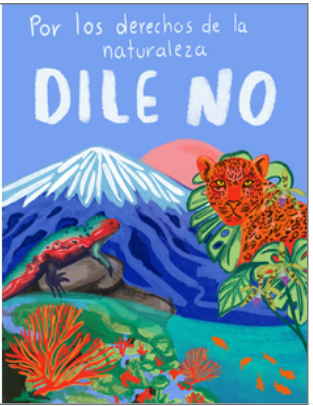
Paper presented at the 76th Annual ICA Conference (Cape Town, 4-8 June, 2026) by Elisenda Ardèvol (Universitat Oberta de Catalunya) and Yadis Vanessa Vanegas-Toala (Universidad Politécnica Salesiana, Ecuador).
The paper “Nature and the land: Grassroots Activism and Environmental Narratives on Social Media: The defense of the ‘Rights of Nature’ in Ecuador” draws on an ongoing research that explores how grassroots environmental activism on social media is reshaping imaginaries of nature amid the climate and ecological crisis.
Within the framework of the FUTURNAT project, this paper focuses on how visual, audiovisual, and memetic practices on platforms like Instagram and TikTok become tools for eco-territorial resistance and the dispute over future horizons. Concretely, this contribution presents a comparative analysis of the notion of “nature” and “land” in the visual narratives of the eco-activists based on a case study centered in media-activist practices in defense of the Rights of Nature during Ecuador’s November 2025 referendum campaign.
While the country was a global pioneer in recognizing these rights in its 2008 Constitution, the current far-right government took a neoliberal offensive with a referendum to re-write the Constitution. The referendum poses two paths: “Yes,” enabling the derogation of the “Rights of nature” and allowing a foreign military base in the Galapagos (among other questions) and “No” defending the current constitution, championed by environmental and Indigenous movements. Yet the outcome was a democratic success: with more than 80 percent voter participation, the “No” vote prevailed. Citizens reaffirmed Ecuador’s pioneering biocentric framework, defending the Rights of Nature against neoliberal pressures and demonstrating the power of collective mobilization.
This historic confrontation fundamentally crystallizes a structural clash between an extractivist imaginary—which reduces the biosphere to commodified supplies—and a relational ontology that centers planetary care. Within this relational framework, a powerful convergence occurs: the scientific arguments of contemporary environmentalism seamlessly blend with the structural logic of Indigenous cosmologies. By operationalizing this synergy, the legal innovation of the “Rights of Nature” leaves behind the status of a rigid juridical mechanism and becomes an active cosmopolitical bridge. It expands the horizons of ecological justice by permanently weaving together the defense of non-human entities with social justice and territorial sovereignty, prefiguring alternative templates to inhabit a shared, sustainable future.
In sum, the recognition of Rights of Nature marks a biocentric turn that reframes ecosystems as subjects of law, resonating with Indigenous cosmologies where rivers, storms, and mountains are beings with agency. This convergence between legal innovation and ancestral worldviews not only enriches juridical thought but also provides a powerful foundation for environmental activism. Defending nature becomes inseparable from defending life, culture, and justice, and activism itself emerges as the bridge that translates these imaginaries into collective action against climate change.